
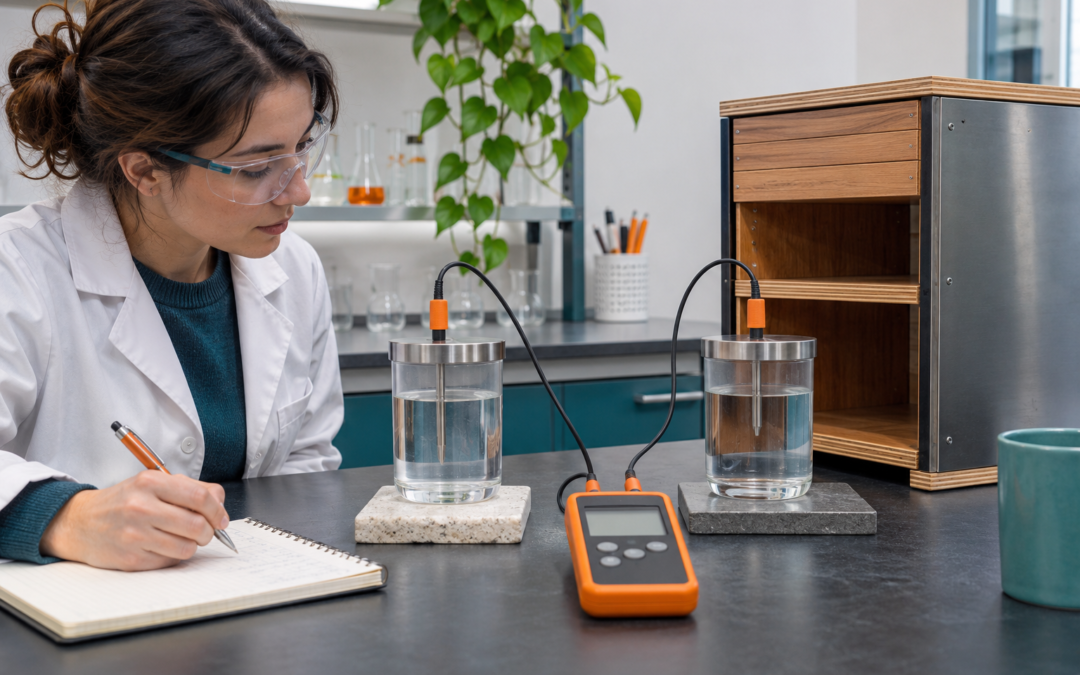
A temperature reading can be interesting. To learn whether a box consistently changes temperature, the comparison has to rule out ordinary sources of heat and measurement error.
Start with a testable question
Historical descriptions identify the orgone accumulator as a box-like structure associated with Reich’s theory. A modern test should state exactly what is being measured. For example: under specified room conditions, does the air inside a particular accumulator become warmer than the air in a matched control enclosure over a set period?
That question is narrower than asking whether “orgone energy” exists. A temperature difference alone would not identify its cause, establish a new form of energy, or show a health benefit. It would be an observation to investigate.
Build a fair comparison
Use two enclosures of the same size and shape, placed in the same room. Define in advance how the test enclosure differs from the control, and document every material and layer. Keep the sensor type, placement, height, recording interval, airflow, distance from windows, and exposure to sunlight consistent. If practical, use multiple calibrated sensors and record the room temperature too.
Swap the enclosures’ positions between runs, randomize which one is measured first, and repeat the procedure on different days. A second person can label the data so the person comparing readings does not know which enclosure is which until the calculations are finished. These simple steps help reduce bias from placement, expectations, and selective reading.
Report uncertainty, not just a striking number
Every thermometer has limits. NIST guidance distinguishes repeatability—agreement under the same measurement conditions—from reproducibility when conditions such as observers or methods change. A useful report would include the instrument, calibration information, sensor positions, room conditions, number of runs, full set of readings, and uncertainty. Publishing the method and raw data makes it possible for another group to repeat the test.
If a temperature difference disappears when the boxes are swapped, sensors are checked, or the work is independently repeated, that matters. If it persists, the next step is to investigate ordinary explanations such as insulation, airflow, radiated heat, and sensor placement before proposing a new mechanism.
Keep physical and medical claims separate
A chamber-temperature experiment can only address a chamber-temperature question. It cannot establish that a device treats illness. Any claim about human health would require a separate, ethically reviewed clinical study with an appropriate comparison group and outcomes chosen in advance. No one should delay or replace medical care on the basis of an accumulator claim.